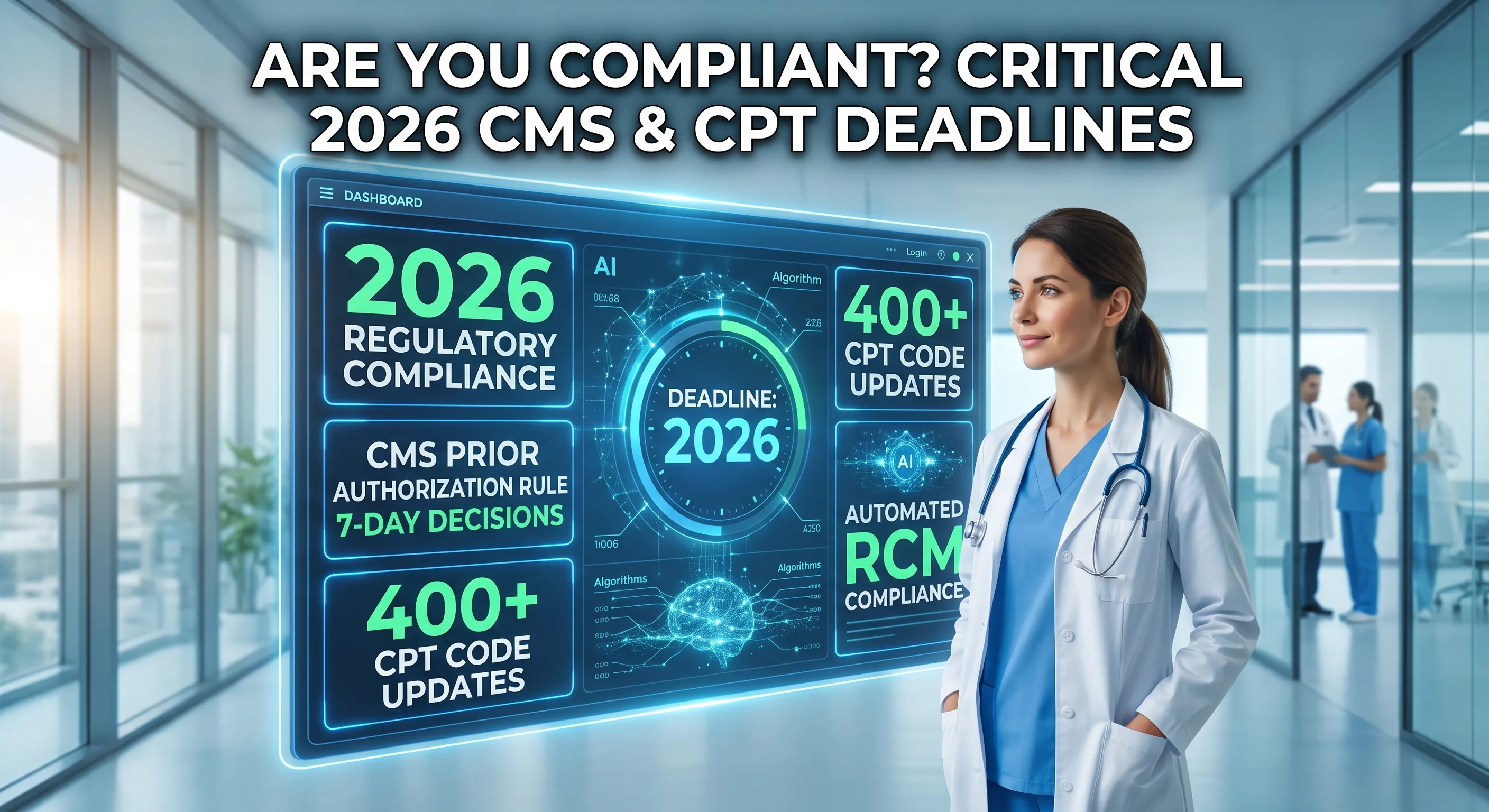
Are You Compliant? Critical CMS Prior Authorization and CPT Deadlines for 2026
With mandatory 7-day prior authorization turnarounds, public denial disclosures, and over 400 new code modifications hitting provider workflows, manual RCM is officially obsolete. Here is how healthcare practices can stay ahead.
The 2026 CMS Mandates: Accelerated Clocks and Public Transparency
The regulatory landscape for healthcare providers and payers has crossed a point of no return. The Centers for Medicare & Medicaid Services (CMS) has codified aggressive standards designed to dismantle longstanding administrative gridlock. Foremost among these changes is the enforcement of shortened adjudication windows for prior authorizations:
Down from the traditional 14-day timeline for standard requests.
Zero room for documentation re-work or manual fax lag.
Approval and denial percentages published openly on public websites.
Furthermore, under the CMS prior authorization rule 2026, impacted payers must publicly post prior authorization metrics on their websites. This includes total approvals, initial denials, overturned appeals, and average response times. For clinical practices, this transparency is a double-edged sword: while payer accountability increases, payers are strictly auditing incoming claims for code-level fidelity to curb their own published turnaround averages.
The 400+ CPT Code Avalanche: Why Manual Workflows Are Collapsing
Simultaneously, the American Medical Association (AMA) has issued more than 400 new, revised, and deleted 2026 CPT code updates. These revisions span emerging clinical technology, artificial intelligence diagnostic modalities, digital therapeutics, and advanced evaluation and management (E/M) subcategories.
The Cost of Manual Latency
Relying on billing staff to manually reference code tables, update cheat sheets, and verify payer-specific medical policies results in an average 38% surge in first-pass rejections during code transition quarters.
When you combine 7-day authorization strictures with hundreds of updated procedural and diagnostic codes, manual verification becomes a mathematical impossibility. By the time a billing specialist identifies an outdated modifier or missing pre-requisite document, the 7-day CMS prior authorization clock has already expired—triggering automated claim delays, administrative denials, and compromised patient care.
Manual vs. Automated Compliance in 2026
| Compliance Parameter | Traditional Manual Workflow | Automated RCM Compliance (ClaimCure) |
|---|---|---|
| CPT Code Adaptation | 30–90 day lag while teams cross-reference annual updates. | Instantaneous real-time rule injection on effective dates. |
| Prior Auth Turnaround | Risks breaching 7-day window due to paper trails & portal logins. | Continuous API tracking ensuring compliance within 48–72 hrs. |
| Error Scrubbing | Human spot-checking catching <65% of modifier mismatches. | Deterministic AI engine validating 100% of pre-submission lines. |
| Denial Rate Exposure | Elevated (Publicly exposed under CMS transparency). | Protected (Sub-3% benchmark maintained consistently). |
ClaimCure.pro: Real-Time AI Rule Enforcement for Flawless Submissions
Manual updates and static rules engines can no longer protect your revenue cycle. ClaimCure.pro re-engineers your billing pipeline by injecting real-time intelligence directly into your claims flow before submission occurs.
Action Checklist: How Practices Must Prepare Now
-
1
Audit Your Current Prior Auth Cycle Time: Measure whether your average submission-to-approval turnaround comfortably sits under 5 calendar days to allow room for unexpected requests.
-
2
Retire Paper-Based and Legacy Portals: Transition to integrated electronic prior authorization (ePA) frameworks compatible with HL7 FHIR APIs mandated by CMS.
-
3
Adopt Real-Time Rules Automation: Eliminate dependency on periodic manual software updates by running claims through ClaimCure.pro's auto-updating rule engine.
Frequently Asked Questions (FAQs)
What changes under the CMS prior authorization rule 2026?
The CMS rule (CMS-0057-F) requires Medicare Advantage organizations, state Medicaid and CHIP agencies, and qualified health plans to provide standard prior authorization decisions within 7 calendar days (cut down from 14 days) and expedited decisions within 72 hours. Additionally, payers must provide specific denial justifications and publicly disclose their prior authorization metrics annually.
How will the 400+ 2026 CPT code updates affect my practice’s cash flow?
Whenever large volumes of CPT codes are added, revised, or deleted, clearinghouses reject submissions that carry outdated codes or improper modifier pairings. If your billing staff relies on manual lookups, claims get rejected on first pass, extending Days Sales Outstanding (DSO) by 30 to 60 days and increasing costly appeal labor.
What is automated RCM compliance, and how does ClaimCure.pro work?
Automated RCM compliance uses algorithmic rules and artificial intelligence to evaluate clinical documentation against updated payer rules and code definitions in real time. ClaimCure.pro ingests CPT code updates and CMS policy shifts instantly, scrubbing claims before they leave your system. This eliminates human error, flags missing documentation, and guarantees your prior auth requests comply with the new 7-day turnaround requirements.
Does public reporting of denial rates apply to healthcare providers?
The direct mandate applies to regulated payers (Medicare Advantage, Medicaid, CHIP, and QHP plans), requiring them to publish approval and denial percentages online. However, this impacts providers directly: payers under public scrutiny will strictly deny non-compliant or incorrectly coded claims rather than allowing manual grace periods, making pre-submission accuracy vital for clinical practices.