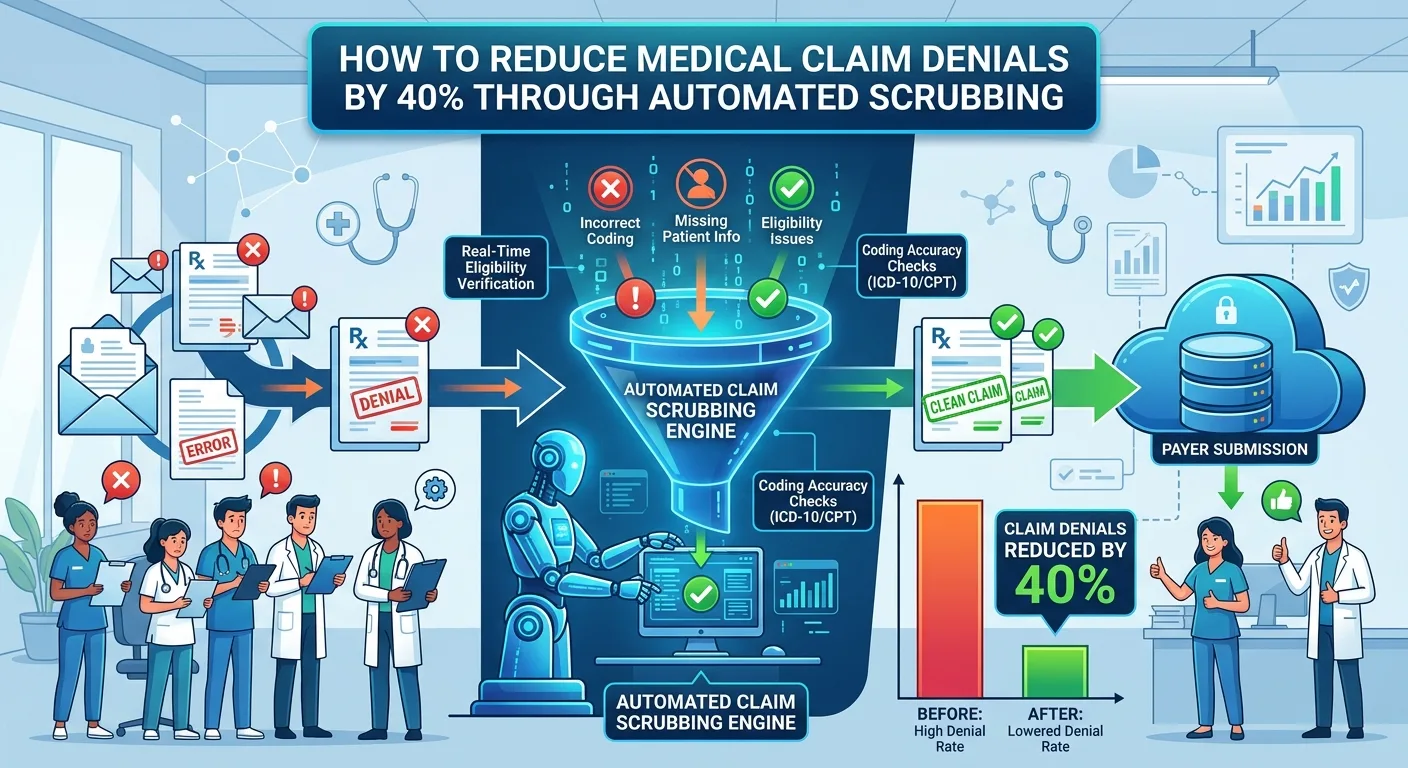
Discover how modern healthcare organizations achieve a 98% Clean Claim Rate, slash administrative rework costs, and recover lost cash flow using real-time automated claim scrubbing engines.
📌 Executive Summary & Key Takeaways
- The Cost of Status Quo: The average cost to rework a single denied medical claim is $25.20 for physician practices and up to $118 for health systems. Up to 60% of denied claims are never resubmitted.
- The 40% Reduction Drivers: Automated scrubbing intercepts front-end eligibility drops, NCCI bundling edits, missing modifiers, and ANSI X12 syntax errors before transmission.
- Real-Time API vs. Batch Processing: Modern scrubbing engines embed directly into EHR/EHR workflows, flagging errors at the point of charge entry instead of late clearinghouse batches.
- Measurable Financial Impact: Elevating Clean Claim Rates (CCR) from 82% to 97% generates hundreds of thousands of dollars in annual labor savings and accelerates cash flow by 18 to 25 days.
1. The High Financial Toll of Preventable Claim Denials
In modern healthcare revenue cycle management (RCM), claim denials represent one of the single largest leaks of practice revenue. Medical practice denial rates historically averaged between 5% and 10%. Today, rising payer complexity, shifting coverage rules, and automated payer adjudication algorithms have pushed initial denial rates over 12% to 15% across many specialties.
According to data from the Medical Group Management Association (MGMA) and the Healthcare Financial Management Association (HFMA):
- The average labor and administrative cost to identify, research, correct, and appeal a single denied physician claim is $25.20. For hospital systems, complex inpatient denial appeals frequently exceed $100 per claim.
- Over 60% of initial claim denials are never reworked or appealed by billing staff due to administrative fatigue, tight filing deadlines, and lack of staffing resources. This represents pure revenue written off directly to bad debt.
- Up to 86% of all denials are completely preventable if caught prior to claim batch transmission.
2. What is Automated Claim Scrubbing? (Architecture & Mechanics)
Automated claim scrubbing is a software-driven process that checks medical claims for accuracy, formatting syntax, clinical logic, and payer-specific guidelines before the claims are submitted to clearinghouses or insurance payers.
Unlike manual biller review—which relies on staff spot-checking complex coding books—automated scrubbing software leverages rule engines, cross-walk databases, and artificial intelligence to validate 100% of claims in milliseconds.
How Automated Claim Scrubbing Differs from Basic EHR Checks
Most Electronic Health Record (EHR) systems contain simple validation checks, such as flagging a missing ICD-10 diagnosis code or an incomplete subscriber ID. However, standard EHR checks fail to catch nuanced payer-specific edits.
Modern Automated Claim Scrubbing Engines sit between the EHR charge capture phase and the Clearinghouse EDI Gateway, operating as an intelligent API-driven firewall:
[ EHR / Practice Management System ]
               │
               ▼ (Real-Time API Check / EDI 837 Payload)
┌────────────────────────────────────────────────────────┐
│             AUTOMATED CLAIM SCRUBBING ENGINE           │
│ ┌──────────────────┐ ┌───────────────────────────────┐ │
│ │  ANSI X12 Syntax │ │  NCCI Edits & MUE Limits      │ │
│ ├──────────────────┤ ├───────────────────────────────┤ │
│ │ Real-Time Eligibility│ LCD/NCD Coverage Rules      │ │
│ ├──────────────────┤ ├───────────────────────────────┤ │
│ │ Payer Policy Rules│ │ ML Predictive Denial Risk     │ │
│ └──────────────────┘ └───────────────────────────────┘ │
└───────────────────────────┬────────────────────────────┘
                            │
               ┌────────────┴────────────┐
               ▼                         ▼
      [ Passed: Clean Claim ]   [ Failed: Auto-Fix / Flag ]
               │                         │
               ▼                         ▼
      Sent to Clearinghouse     Returned to Biller Dashboard
      (98%+ Clean Claim Rate)   (With Precise Resolution Code)
3. The 4 Core Layers of Automated Claim Scrubbing
To reduce claim denials by 40% or more, an automated scrubbing system must evaluate claims across four distinct logical layers prior to submission:
Layer 1: ANSI X12 EDI Format & Syntax Rules
Medical claims transmitted electronically follow strict ANSI ASC X12 standards (837P for Professional claims and 837I for Institutional claims). Minute syntax mistakes cause immediate clearinghouse rejections.
- Loop 2000A / 2010AA: Validates Billing Provider NPI, Tax ID (TIN), and Taxonomy codes.
- Loop 2300: Checks Claim Information, Prior Authorization numbers, and Occurrence Codes.
- Loop 2400 (SV1/SV2 Segments): Verifies Procedure Codes (CPT/HCPCS), Line-Item Charges, Unit Counts, and Diagnosis Pointers.
Layer 2: Real-Time Patient Eligibility & Demographic Matching
According to industry surveys, over 40% of initial claim denials stem from front-office registration and insurance eligibility errors (e.g., Claim Adjustment Reason Code CO-27: Expenses incurred after coverage terminated).
Automated scrubbing engines query clearinghouse 270/271 real-time eligibility endpoints to confirm:
- Active policy status on the specific DOS (Date of Service).
- Exact Subscriber ID, Group Number, and Relationship Code.
- Primary vs. Secondary payer order (Coordination of Benefits).
Layer 3: NCCI Edits, MUEs, and Clinical Coding Bundling
The Centers for Medicare & Medicaid Services (CMS) updates National Correct Coding Initiative (NCCI) edits quarterly. Scrubbing engines automatically check claims against:
- Procedure-to-Procedure (PTP) Edits: Prevents billing code combinations that should not be reported together (e.g., CPT 29881 - Arthroscopy with meniscectomy and CPT 29870 - Diagnostic arthroscopy).
- Medically Unlikely Edits (MUEs): Flags claims where the units of service exceed reasonable clinical limits (e.g., billing 5 units of a single-dose injection code).
- Modifier Automation: Automatically identifies where distinct procedural modifiers (e.g., Modifier 25, Modifier 59, or XE/XS/XP/XU) are required to unbundle legitimately separate procedures.
| Edit Type | Scenario Example | Common CARC / RARC Code | Automated Scrubbing Action |
|---|---|---|---|
| NCCI PTP Edit | Billing CPT 99214 (E/M) and CPT 17000 (Lesion Removal) without modifier. | CO-97 (Procedure bundled into primary service) |
Flags missing Modifier 25 on Evaluation & Management code prior to claim creation. |
| MUE Limit Exceeded | Billing 8 units of CPT 97110 (Therapeutic Exercise) in a 1-hour session. | CO-119 (Maximum benefit exceeded) |
Caps maximum allowable units based on clinical guidelines before submission. |
| LCD / NCD Medical Necessity | Ordering MRI (CPT 70551) with non-covered primary diagnosis (e.g., tension headache). | CO-50 (Non-covered service due to lack of medical necessity) |
Cross-checks ICD-10 code against local coverage determination (LCD) rules in real time. |
| Expired Prior Authorization | Submitting surgery claim without Prior Auth code in Loop 2300 REF*G1 segment. | CO-197 (Precertification/authorization absent) |
Matches authorization database and injects valid auth code into claim segment. |
Layer 4: Machine Learning & Historical Denial Pattern Recognition
The most advanced automated scrubbing tools analyze historical remittance advice (835 ERA data). By tracking which code combinations resulted in CO-16 (Claim lacks information) or CO-45 (Charge exceeds fee schedule) from specific regional payers, the engine creates dynamic, self-learning scrubbing rules tailored to your payer mix.
4. Step-by-Step Blueprint: Achieving a 40% Denial Reduction
Achieving a 40% reduction in claim denials is not an overnight fluke—it requires aligning billing software automation with structured clinical workflows. Here is the 5-step operational blueprint:
Step 1: Shift Scrubbing Upstream (Point-of-Care Validation)
Traditional billing workflows run claim checks days or weeks after the patient encounter. By embedding automated scrubbing into the clinical chart closure or checkout workflow, physicians and medical coders receive immediate alerts for missing documentation or invalid code pairs while the clinical encounter is still fresh.
Step 2: Automate Payer-Specific Rule Updates
Payer rules change constantly. Commercial insurers frequently adjust clinical policies without major announcements. Automated cloud-based scrubbing platforms update rule sets overnight across thousands of commercial payers, Medicare MACs, and Medicaid managed care plans, ensuring rules never fall out of date.
Step 3: Implement Automated Modifier Logic
Modifier errors are one of the top causes of claim delays. An automated engine enforces modifier application logic based on exact NCCI indicator status:
- Modifier Indicator "0": Codes cannot be unbundled under any circumstances. The scrubbing system flags the secondary code for removal to prevent an outright denial.
- Modifier Indicator "1": Codes may be unbundled with an appropriate modifier (e.g., 59, XE, XS). The scrubbing system verifies clinical documentation supports a separate anatomical site or session and prompts the coder to apply the modifier.
Step 4: Establish Closed-Loop Biller Error Dashboards
When the automated scrubber flags an error, it shouldn't just reject the claim—it must provide actionable feedback. Modern dashboards display explicit resolution instructions (e.g., "Payer A requires rendering provider taxonomy in Loop 2310B PRV segment for CPT 99213").
Step 5: Continuously Refine Rules Using 835 ERA Data
Feed 835 Electronic Remittance Advice data back into the scrubbing platform monthly. If a new denial code begins appearing (e.g., a sudden spike in CO-252), the automated engine creates a temporary rule to block similar claims until the root cause is resolved.
5. Quantitative Financial Breakdown & ROI Savings Model
To understand how automated scrubbing generates massive financial return, let's examine a practice processing 10,000 claims per month with an average claim reimbursement value of $150.
| Metric / Parameter | Before Automated Scrubbing | After Automated Scrubbing | Net Financial Impact |
|---|---|---|---|
| Monthly Claim Volume | 10,000 claims | 10,000 claims | — |
| Clean Claim Rate (CCR) | 82% | 97% | +15% Increase |
| Initial Denial Volume | 1,800 denied claims/mo | 300 denied claims/mo | 1,500 Fewer Denials (83% Drop) |
| Cost to Rework Denials (@ $25.20/claim) | $45,360 / month | $7,560 / month | $37,800 Monthly Labor Savings |
| Unappealed Written-off Revenue (60% of Denials) | 1,080 claims x $150 = $162,000/mo | 180 claims x $150 = $27,000/mo | $135,000 Monthly Recovered Cash |
| Annualized Bottom-Line Value | $2,488,320 total loss/costs | $414,720 total loss/costs | $2,073,600 Annual ROI Value |
6. Manual vs. Legacy vs. Next-Gen Automated Scrubbing
| Feature / Capability | Manual Biller Review | Legacy EHR Rules Engine | Next-Gen AI Automated Scrubbing |
|---|---|---|---|
| Speed per Claim | 5 – 10 minutes | 1 – 2 seconds | < 50 milliseconds |
| Coverage of Payer Rules | Low (Staff memory dependent) | Moderate (Static rule sets) | Exhaustive (Dynamic cloud updates) |
| ANSI X12 Syntax Validation | None | Basic EDI checks | Full Loop & Segment Inspection |
| Real-Time Eligibility Querying | Manual portal lookup | Batch overnight run | Instant 270/271 API Check |
| Predictive Denial Prevention | No | No | Yes (Machine Learning via 835 ERAs) |
| Typical Clean Claim Rate | 75% - 82% | 88% - 92% | 97% - 99% |
7. 5-Step Implementation Plan for Healthcare Providers
Transitioning to an automated claim scrubbing workflow requires structured change management. Follow these five key milestones for a smooth deployment:
-
Perform a Baseline Denial Audit: Extract 90 days of 835 remittance data to categorize your practice’s top CARC/RARC denial codes (e.g.,
CO-16,CO-27,CO-97,CO-197). - Establish EHR / Practice Management API Integration: Ensure your automated scrubbing engine connects bidirectionally via REST APIs or HL7/FHIR interfaces so error alerts return straight to charge entry screens.
- Configure Specialty-Specific Rule Sets: Tailor the scrubbing rules to your clinical focus (e.g., Orthopedics, Cardiology, Dermatology, or Hospital Outpatient) to account for specialized billing modifiers and NCCI unbundling rules.
- Train Front-Office and Billing Staff: Educate staff on responding to pre-submission scrubber prompts. Ensure front-desk teams understand how registration errors directly trigger downstream denials.
- Monitor Weekly KPIs: Track your First-Pass Clean Claim Rate (CCR), Days in AR, and Initial Denial Percentage weekly. Target a CCR of 95% within the first 30 days and 98% by day 90.
8. Frequently Asked Questions (FAQ)
What is automated claim scrubbing in medical billing?
Automated claim scrubbing is a software-driven pre-submission validation process. It checks medical claim data against payer-specific billing rules, coding edits (like NCCI and MUEs), patient eligibility records, and ANSI X12 syntax standards prior to submission to payers or clearinghouses.
How does automated claim scrubbing reduce medical claim denials by 40%?
By intercepting common errors—such as missing subscriber IDs, incorrect NCCI code pairs, missing modifiers, or unverified prior authorizations—at the point of charge entry, automated scrubbing stops bad claims before they ever reach the insurance payer.
What is a good Clean Claim Rate (CCR) benchmark?
The industry benchmark for a healthy Clean Claim Rate is 95% or higher. Organizations leveraging modern automated claim scrubbing engines routinely achieve Clean Claim Rates between 97% and 99%.
How much does it cost to rework a denied medical claim?
Industry studies from MGMA and HFMA show that reworking a denied physician claim costs an average of $25.20 in labor and overhead. Hospital inpatient denials can cost $103 to $118 per claim.
9. Conclusion & Actionable Next Steps
In an environment of tightening reimbursement margins and escalating payer scrutiny, relying on manual claim reviews or outdated EHR validation rules is no longer viable. Automated claim scrubbing transforms revenue cycle management from a reactive appeal process into a proactive revenue acceleration engine.
By preventing initial claim denials, reducing administrative rework costs, and achieving a 98% Clean Claim Rate, healthcare organizations can protect their financial bottom line while freeing staff to focus on patient care.
Ready to Elevate Your Clean Claim Rate to 98%?
Schedule a personalized revenue cycle assessment today to discover how automated claim scrubbing can eliminate initial denials and recover hidden cash flow for your medical practice.
Book Your Free RCM Audit